
Growing companies rarely plan their physical space before it becomes a problem.
In most cases, the office only becomes a topic of discussion when it is already cramped, noisy, disorganized, or clearly incompatible with current operations.
It is at this point that quick decisions emerge: redistributing desks, closing off a room, occupying improvised areas, or adapting the layout “however possible.” What seems like a practical solution often leads to recurring mistakes in architecture for growing companies—mistakes that directly affect productivity, costs, and institutional image.
This article examines the main errors companies make when adapting their offices during periods of growth, explaining why they happen and how architecture for businesses should take a strategic role in this process.
The challenge of growth within the same space
As a company grows, its workspace stops being just an address. It begins to directly impact:
- productivity
- communication between teams
- organizational culture
- talent retention
- institutional image
The initial mistake is often treating the office as a secondary concern—something that can be “adjusted little by little.” In practice, poorly planned adaptations accumulate silent problems that only become evident when the cost of fixing them is already high.
Architecture for growing companies should not begin when the space is already saturated, but earlier—when there is still room for strategic decisions.
Common mistakes when adapting office space in corporate architecture
Mistake 1: Failing to consider company growth and how space is used
When a company grows, it doesn’t grow only in headcount—it grows in complexity. New departments emerge, leadership structures evolve, communication flows change, and different needs arise for focus and collaboration.
Corporate architecture must evolve alongside this transformation. When it doesn’t, the space starts working against the operation. The layout no longer supports daily activities and instead creates noise, circulation conflicts, and efficiency losses.
A common mistake is believing that growth can be solved simply by adding more workstations. In reality, growth requires spatial reorganization, clear zoning, and environments suited to different ways of working.
Mistake 2: Adapting the office without an architectural diagnosis
One of the most frequent mistakes is starting to adapt the space without an architectural diagnosis. The company realizes the office feels too small and begins making changes before fully understanding how the space currently functions.
Without a proper corporate architecture assessment, critical decisions are made blindly. Rooms are created where they shouldn’t be, support areas disappear, and circulation becomes confusing. The office ends up being occupied in an improvised way, and each new adjustment creates another problem.
The diagnosis is what makes it possible to understand physical constraints, expansion possibilities, and hidden conflicts. Without it, architecture stops being strategic and turns into a series of patchwork solutions.
Mistake 3: When adaptation becomes just a furniture rearrangement
Another common mistake is treating space adaptation as nothing more than rearranging furniture. Moving desks around or squeezing in more workstations may solve an immediate issue, but it rarely addresses the underlying structural problem.
Architecture for growing companies goes far beyond furniture. It involves infrastructure, acoustics, lighting, circulation, ergonomics, and the relationship between different areas. Without an architectural project, the office loses coherence and becomes difficult to use on a daily basis.
Over time, these improvised decisions compromise the employee experience and make space management increasingly challenging.
Mistake 4: Failing to consider the impact of space adaptation on daily operations
Adapting an office almost always involves some level of construction or physical intervention. When this impact is not planned, it directly affects the company’s operations.
Noise, constant changes, restricted areas, and temporary solutions undermine productivity, concentration, and organizational climate. Many companies underestimate this impact and only recognize the issue once daily routines have already been disrupted.
Architecture for growing companies must consider not only the final space, but also the adaptation process itself. Planning phases, timelines, and disruptions is essential to ensure the company can continue operating while the environment is being transformed.
Mistake 5: Failing to adapt the space to the company’s architecture, culture, and stage of growth
Another recurring mistake is adapting the space without considering the company’s culture and current stage. Growth brings significant internal changes: new teams, new leaders, and new ways of working.
When architecture does not reflect this reality, the space becomes misaligned. Overly rigid environments, inflexible layouts, or generic solutions fail to keep up with the company’s dynamics and end up creating internal barriers.
Architecture for companies should translate the business’s current moment into physical space, creating environments that are coherent with how the company actually operates.
Mistake 6: Fragmentation between design, construction, and management
In many office adaptations, design, construction, and execution are treated as separate stages, without centralized coordination. The company ends up assuming the role of process manager—mediating technical decisions and resolving conflicts between suppliers.
For growing companies, this represents a high hidden cost: leadership time diverted to operational issues. Integrated corporate architecture models, such as turnkey, exist precisely to reduce this kind of strain and bring greater predictability to the process.
When adapting the space is no longer the best decision
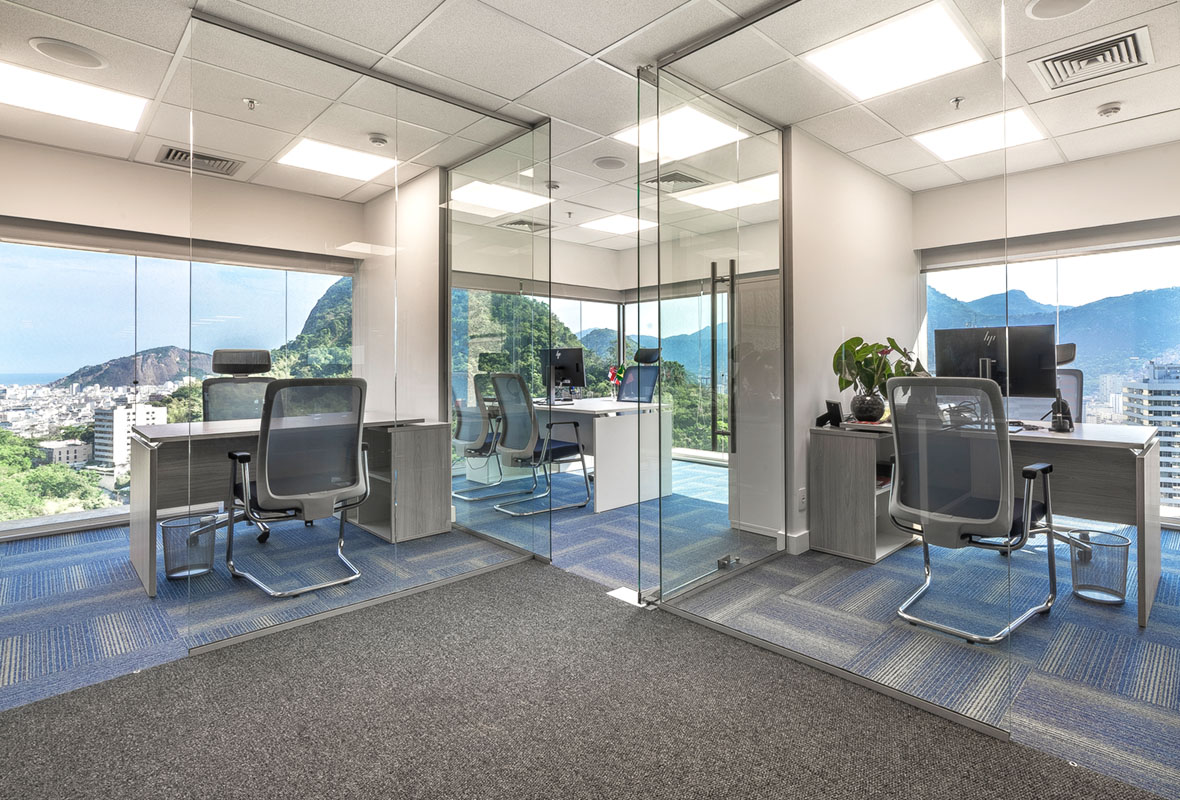
There are situations in which continuing to adapt the same office is no longer strategic. Physical limitations of the building, recurring conflicts, and the need for frequent renovations indicate that the space can no longer keep up with the company’s growth.
Architecture helps evaluate whether adaptation still makes sense or if relocating headquarters becomes the most efficient solution. This decision should not be intuitive, but based on technical and operational analysis.
The strategic role of architecture for growing companies
When applied correctly, architecture for growing companies stops being reactive and starts organizing the future. It helps structure workflows, anticipate needs, reduce improvisation, and create more efficient, balanced environments.
Companies that grow without this support accumulate silent problems. Companies that use architecture as a strategic tool are able to grow with greater control, clarity, and quality in the workplace.
Growth is positive. Growth driven by improvisation is expensive. Architecture exists to turn expansion into structure.
View architecture projects for growing companies
Talk to our team and evaluate the best way to adapt your space